The Federal Competence Center for Labor Productivity uses its IT platform as the core digital environment for interacting with program participants and governing bodies, including enterprises, regional competence centers, and oversight agencies.
The platform operates at a federal scale, supporting over 300,000 active users with high transaction volumes and constant user interaction. Consequently, when developing new functionality, we prioritized performance, fault tolerance, and change management from the start, ensuring all updates were compatible with continuous operation and did not degrade system performance under load.
The platform is built on a role-based model: each user group has a dedicated dashboard with specific access rights, interfaces, and workflows. There are over ten user types in the production environment, as the needs of an enterprise, a regional center, and an oversight body differ significantly—ranging from operational tasks like request processing and implementation to performance monitoring and management analytics.
Development of the federal IT platform and business modules
BPA’s role in the project was to develop the FCC’s federal platform, which involved refining key modules and user dashboards used by enterprises to implement "Best Practices."
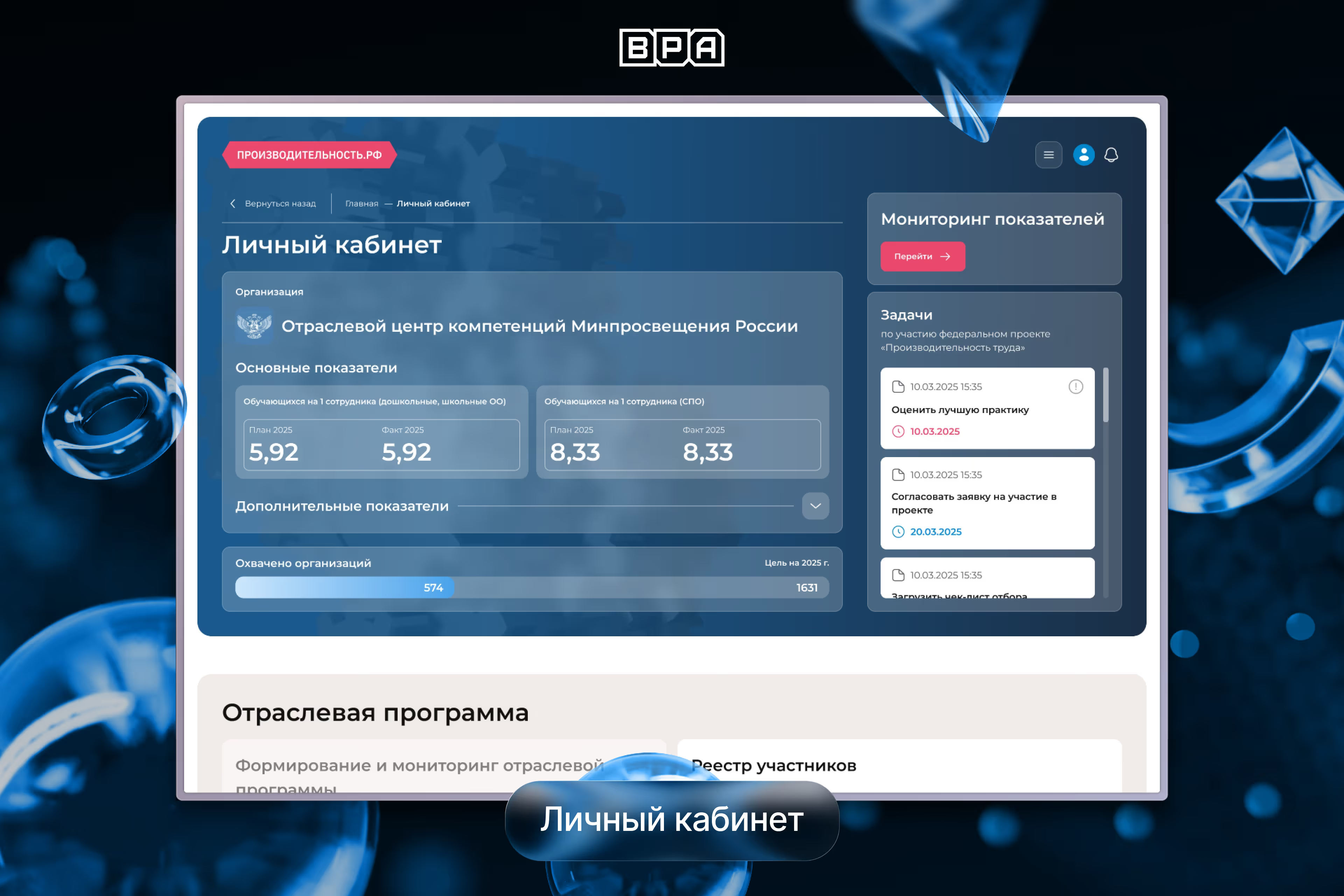
This included developing functionality for selecting and supporting best practices, managing workflows for requests, reports, and approvals with federal and regional oversight bodies, as well as services used in daily enterprise operations: an LMS for employee training, benchmarking (a service for evaluating economic indicators by industry), and an admin panel for managing content across the entire IT platform.
Development of an AI assistant, BI system, and analytical dashboards
A key focus of the project was the development of an LLM assistant and a new analytical framework for the federal platform.
We created an AI consultant for users, trained on the FCC knowledge base and integrated directly into the system's workflow. The assistant helps users find relevant practices, methodological materials, recommendations, and answers to questions tailored to the specific profile of their enterprise or institution. When generating responses, the system considers the user's context, helping them navigate the platform's vast repository of expertise more efficiently.

The primary goal of the solution was not just to create a standalone chatbot, but to provide convenient access to the knowledge and best practices available on the federal platform. This reduced information search time, increased the accessibility of expert materials, and simplified user interaction with FCC digital services.
In parallel, the BPA Technologies team developed a new analytical framework for the platform. This included BI dashboards featuring reporting metrics, macro- and micro-indicators for the Russian Federation, and analytical panels tailored for various user categories: enterprises, regional competence centers, and governing bodies.

Special attention was paid to data quality and the methodology for calculating indicators. Working closely with the client, we defined data sources, calculation rules, assumptions, and metric interpretations to ensure that results were reproducible and consistent across all platform modules.
A manual data management circuit was also implemented. Some metrics and plans required manual entry and adjustments, and external data was not always available through automated integrations. To address this, we developed a separate interface for data loading and management, which includes editing, change logging, and version control.
As a result, the client received a unified analytical ecosystem that integrates business intelligence, reporting, and intelligent knowledge search tools, which improved data accessibility and user efficiency across the federal platform.
Legacy system modernization and the transition to microservices architecture
The engineering phase of the project involved working with accumulated legacy code and a poorly documented data structure. This meant that before any improvements could be made, we first had to carefully map out dependencies—identifying which modules and data were linked and how changes would impact the system—to ensure that updates did not lead to unexpected failures.
As part of the project, we began transitioning from a monolithic to a microservices architecture: the modules we developed and enhanced were separated into independent services. Simply put, instead of one large "lump" of logic, parts of the functionality were moved into standalone components with clearer boundaries. This reduced component coupling, allowed for independent development of individual parts, and minimized the risk of cascading regressions, where a fix in one area unexpectedly breaks another.
Given the federal scale and the large number of concurrent platform users, we worked in parallel to improve performance and stabilize system behavior. In practice, this involved systematic backend and frontend development within the live environment: analyzing and refactoring critical sections, refining domain boundaries for modules, moving logic into a service layer, strengthening the analytical circuit (dashboards, metrics, and user portals), and bringing changes to production-grade quality while maintaining continuous service operation.
Data structuring and working with 1,500+ tables
The most significant challenge of the project was not related to any single module, but rather to how the data layer was structured and how analytics relied upon it. In the original environment, the client essentially had two different databases containing a massive array of "raw" primary data, totaling approximately 1,500 tables. For large, long-standing government platforms, this is a typical situation: data accumulates over years, teams and requirements change, and a unified formalization of the domain model and a "map" of the storage often fail to keep pace with development.
At this point, we took on the task of inventorying and structuring the data: we reconstructed the logic of the relationships, identified primary and derived entities, and uncovered duplication and areas of actual usage. We applied clustering and systematization methods to the array of tables and relationships to accelerate initial navigation of the storage and build a clear structure for future changes. This created the foundation without which the development of analytical modules would have inevitably yielded inconsistent results and required constant manual corrections.