
Development of a Robot Fleet Monitoring and Management Platform
For BPA, this was a custom software development project: building a fleet monitoring and management platform, a BI system, and a corporate web service for industrial robot operations. We established a full-cycle telemetry workflow and implemented application-specific management modules. The project scope included data collection and processing, user interface design, administrative maintenance mechanisms, and integration with 1C at the level of stock items and identifiers.

The project required the creation of a unified IT platform for fleet tracking that would integrate operational data, analytics, and service processes. In terms of requirements, this meant:
- providing the operations manager with an up-to-date overview of each robot and the fleet as a whole;
- verifying actual work performed on routes and during deployment sessions (confirming movement and activity);
- supporting the service lifecycle (statuses, repairs, tickets, downtime, and deadline tracking);
- tracking robot configurations and ensuring component traceability linked to 1C inventory records.

Telemetry Processing and Data Normalization
The platform is built on a data-driven foundation. We organized the ingestion of raw logs from devices, implemented cleaning and normalization, standardized the data structure, and configured regular updates. This telemetry processing system allowed us to move from a "collection of events" to reproducible metrics that are interpreted consistently across all system modules and used for management analytics. Additionally, we configured exports and data dumps so that the information could be used in the client's related analytical processes and reporting.
Robot Fleet Operational Analytics
The platform displays actual robot performance over a selected period: distance traveled, time spent moving versus idling, metrics by operating mode, period-over-period trends, and comparative analysis between robots. For the operations manager, this operational fleet analytics serves as a tool to quickly identify deviations and manage the fleet based on actual data: where downtime is increasing, which robots are underperforming, and how productivity changes under different modes and operating conditions.
Routes and Sessions on the Map
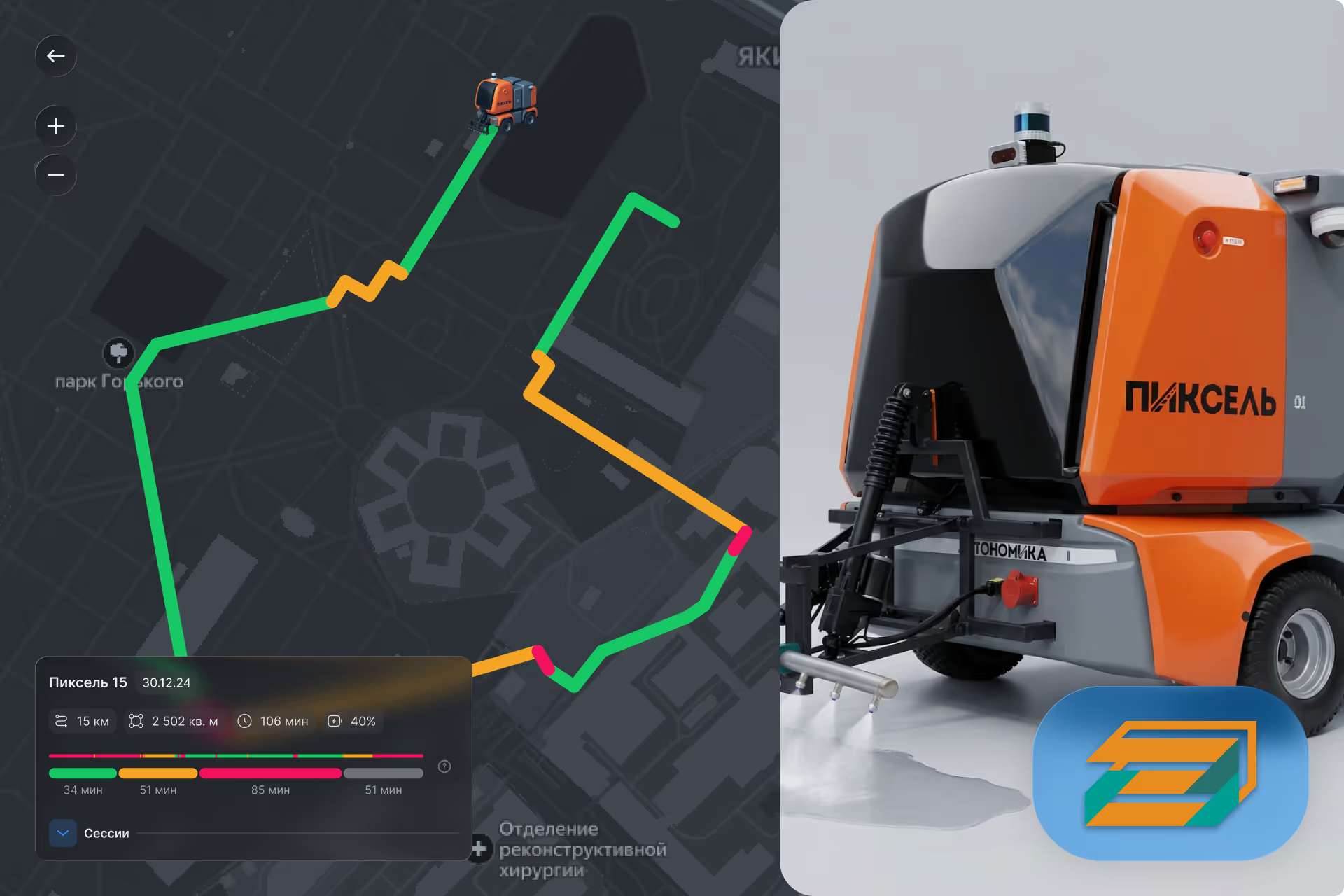
We implemented visualization for deployment sessions and actual routes. Essentially, this is a route and session monitoring dashboard that helps verify work completion: where the robot actually traveled, which zones it covered, how long it was active, and how this compares to the plan. This reduces "claimed vs. performed" disputes and speeds up the investigation of deviations without needing to visit the site.

Service management, repairs, and downtime
As part of the digital service development, we built a service management module that tracks robot statuses, events, and service requests, while monitoring downtime and repair timelines. The system allows for managing maintenance as a structured process: identifying prolonged repairs, tracking service staff workload, assessing the impact of downtime on overall performance, and making timely decisions regarding repair acceleration or component replacement.
Robot configuration and 1C warehouse integration
A separate module was implemented for specific robot configurations—a "machine passport" containing version details, installed assemblies, and components. This module is linked to 1C inventory management: as part of the integration, every part is assigned a status of "in stock / installed / written off," and during assembly or repair, it is tied to a specific warehouse item and 1C identifier. As a result, component replacements are fully traceable: it is clear what was previously installed on a robot, what was written off, and what was installed as a replacement, all with accurate accounting records.
To support ongoing operations, an administrative section was implemented for managing formulas, coefficients, and update parameters. This is essential for platforms involving analytical dashboard and BI platform development, where calculation rules are refined as statistics accumulate and operational protocols evolve.

Technology stack
The platform serves as a centralized control hub for the robot fleet: it collects telemetry, calculates operational metrics, displays routes and service events, and links robot data with warehouse inventory and equipment repair records.
As the fleet grows, the stability of updates and the platform's ability to process an increasing stream of events without analytical delays become critical. Therefore, the solution was designed with scalability in mind and falls under the category of information and analytical system development and implementation projects.
The analytical module includes a roadmap for incorporating artificial intelligence and machine learning—specifically predictive analytics for forecasting mileage, potential breakdowns, and component wear based on accumulated operational data.