
Modern retail is increasingly shifting from manual control to data-driven management. For retail chains, it is crucial not only to see what is happening in the store but also to quickly understand where losses occur, which zones are most effective, how customer behavior changes, and how promptly staff respond to events on the sales floor.
As part of the project, BPA Technologies developed an intelligent platform for a smart store that combines several technologies into a single analytics and management system. The solution processes video streams, data from RFID tags, and IoT devices, handling events in real time and generating actionable business analytics.

The platform is powered by computer vision-based video analytics: the system analyzes video streams, recognizes events in the retail space, and helps turn camera data into management analytics for retail.
The platform was prepared for demonstration at the unmanned systems exhibition in Skolkovo as part of the "Made in Moscow" program: in 10 days, the team adapted the system to the client's requirements, configured operational scenarios, and ensured stable performance under high-load conditions. This format allowed for the presentation of a comprehensive technological AI system that can be scaled to meet the needs of retail chains.
The project requirements included:
- adapting AI models for retail tasks;
- configuring shelf monitoring and planogram analytics;
- implementing RFID product control scenarios;
- integrating heat maps and customer analytics;
- ensuring real-time video stream processing;
- preparing visualization and interfaces for the demonstration;
- integrate the system directly into the exhibition booth infrastructure.
The challenge was compounded by the fact that the system could not just look like a prototype; it had to function as a full-fledged industrial solution with live analytics, real-world scenarios, and stable event processing under high load and the constant flow of exhibition visitors.
The project was developed for demonstration at the unmanned systems exhibition in Skolkovo as part of the "Made in Moscow" program, making the extremely tight implementation timeline a key challenge.
Solution Architecture
The platform was built as a modular AI system capable of integrating into existing retail infrastructure without requiring a complete equipment overhaul.
The solution is based on:
- computer vision algorithms;
- object detection models;
- multi-object tracking;
- RFID infrastructure;
- behavioral analysis ML models;
- IoT components;
- analytical backend platform;
- notification and reporting system.
The architecture allows the solution to scale from a single store to a distributed national chain.
Automated shelf monitoring and inventory control
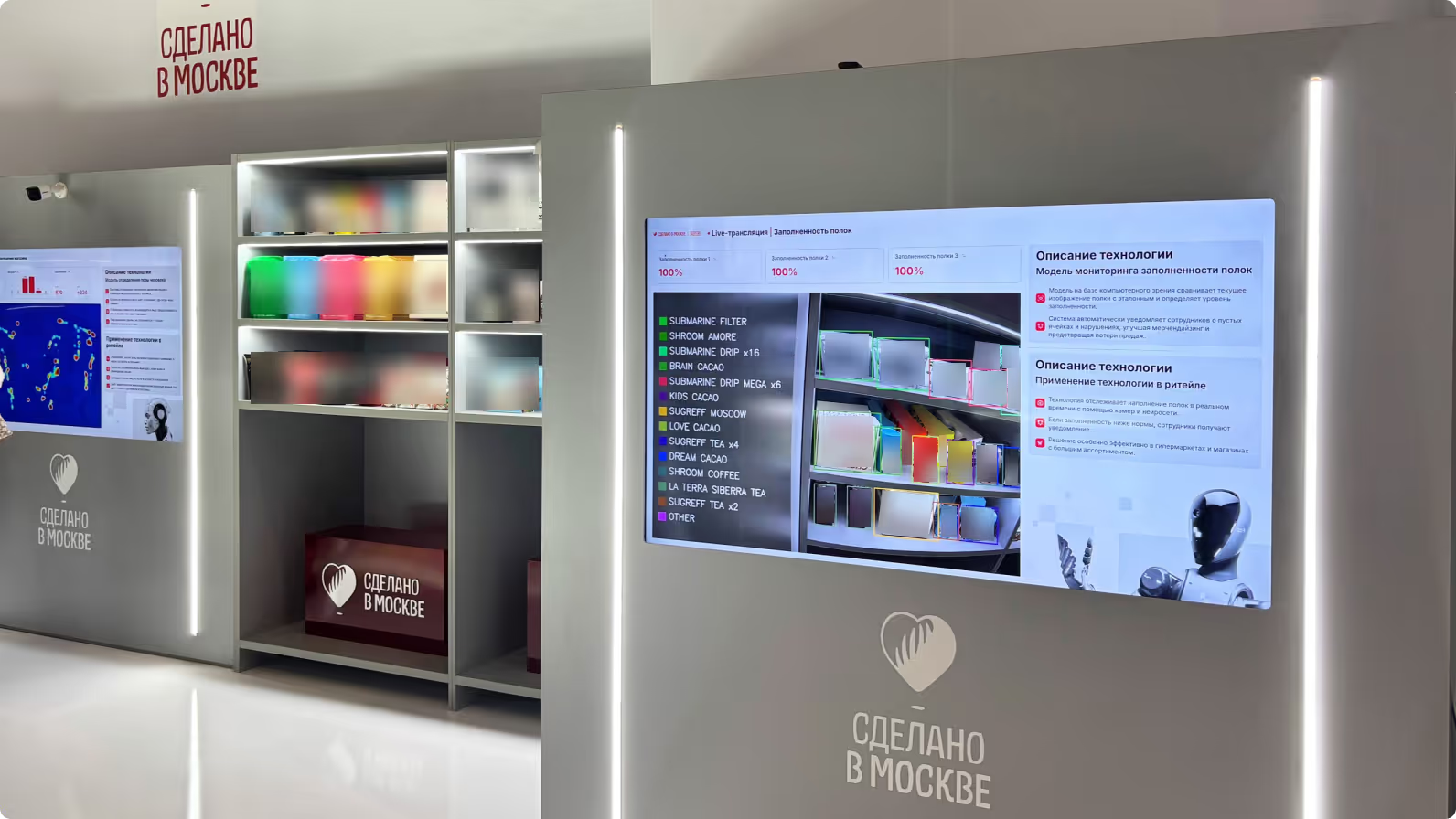
A key component of the system is the AI shelf monitoring module. It uses cameras and computer vision algorithms to analyze shelf status in real time, identifying product availability, shelf fill levels, empty spots, changes in product placement, and instances of items being picked up by customers.
This is particularly important for retail, as an empty shelf means lost sales. If a product is out of stock or has been removed, the system logs the event and can send a notification to store staff. Instead of constant manual checks, personnel receive alerts only when action is actually required.

The AI models were tuned to operate in booth conditions and typical retail environments, accounting for varying lighting, high product density, object occlusion, changing camera angles, and constant customer movement. This allowed the system to analyze real-world scenarios that stores face every day, rather than just "ideal" conditions.
A key task of the module is shelf-level product recognition:
- which areas attract the most attention,
- how quickly shelves are emptied,
- which products require more frequent restocking,
- how effectively the merchandise is displayed.
For store managers and category managers, this module serves as an operational management tool that helps them respond to changes faster and make data-driven decisions.
RFID Loss Prevention System
For the apparel and accessories section, the BPA team implemented an intelligent RFID module for tracking product movement.
Unlike traditional anti-theft systems, this solution does more than just detect when an item is removed; it allows for full lifecycle tracking of each individual item within the store.
The system knows:
- which item was taken from the rack;
- in what size;
- in what color;
- how many units are left;
- whether the item was returned to the rack/shelf;
- whether the item passed through the checkout.

This type of RFID product control is particularly relevant for apparel and accessory retail, where it is important to track not just the product category, but the specific unit: model, color, size, and stock level. Furthermore, the RFID module functions not only as a security feature but also as an inventory analytics tool.
Retailers receive data on model demand, display effectiveness, and inventory levels. This helps improve inventory management, identify problem areas faster, and strengthen loss prevention in retail.
Customer Behavior Analysis and Heat Maps
The third module of the platform handles behavioral analytics on the sales floor. The system uses multi-object tracking, human pose estimation, AI-driven trajectory processing, and customer heatmaps to visualize how shoppers move through the store and interact with the retail space.
Algorithms identify the most visited zones, areas with low engagement, customer traffic patterns, and spots where visitors linger the longest. This helps retailers understand which shelves, promotional areas, and advertising displays truly capture attention and which go unnoticed.

Additionally, the system analyzes traffic intensity and determines basic audience characteristics, including gender and age groups. No personal data is stored; the platform uses anonymized analytics and is designed for evaluating customer flow behavior rather than identifying individuals.
The customer behavior analysis module helps drive data-informed decisions: rearranging products, adjusting promotional zones, optimizing in-store routes, and allocating staff more effectively.
Project Results
In just 10 days, the BPA Technologies team completed the full cycle of preparing the system for demonstration: adapting the solution to the client's requirements, configuring operational scenarios, integrating hardware into the exhibition booth, preparing analytics interfaces, and training the client's staff on the system.
The solution was integrated into the booth's actual mechanics rather than being presented as a static prototype. Throughout the 4 days of the exhibition, the store video analytics system operated reliably under high visitor traffic: people interacted with products, moved them around the demo store, changed shelf stock levels, and created real-world events for analysis. The platform processed these actions in real time and displayed the results in the interface.
Following the demonstration, the collected data and analytics were handed over to the client, including anonymized information about visitors, their behavior within the booth space, traffic intensity, and interactions with product zones.